The Point contains everything he is. His loneliness precedes creation, and his regret becomes part of its record. In the Sacred copy, fullness overflows; the Sethite account gives the madness in his own words.
Qadmaita, pp. 13, 21, 35.
Creation and the Point
The first creation account asks what it means to make a world while alone. Uriah speaks; the thought comes back unchanged. Sodom emerges from the storm. Later the Apology gives the maker’s regret a place within the sacred record.
Qadmaita, Book One, The Point (p. 35), The Storm (p. 40), and The Apology (p. 55).
The Primangels and Guardians
Mikha’el, Caligra and Malachi are spirits revived by the Lord and given forms to guard the world. A Primangel is a human bearer of a celestial office. Susar, Nebiar and Ensar name offices held by Seth, the Traveler and the old king respectively.
Qadmaita, glossary, pp. 18–19; Batraita, Book Fourteen.
Giants and Colossi
The compiler calls the sons of Sodom Giants and gives Nebuchadnezzar first place among them. Colossi are a lesser order. Four governors stand behind the courts of Syria, Persia, Egypt and Rome, so earthly politics becomes part of the supernatural story.
Qadmaita, pp. 17–18; Mes’aita I, pp. 11–12.
The Realms
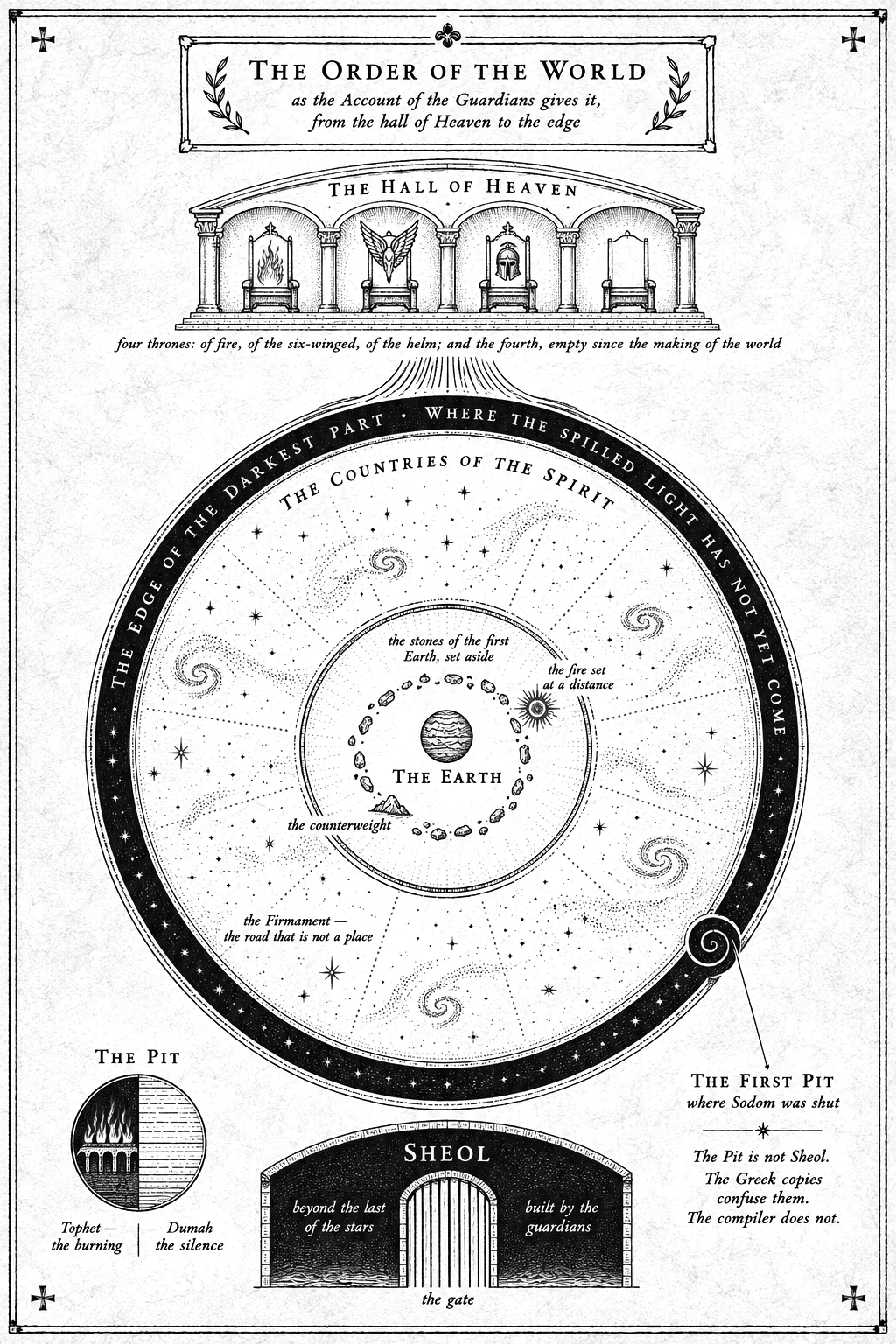
The Firmament connects the countries of the universe. The Edge lies beyond the reach of the spilled light. In the Pit, Tophet is burning and Dumah is silence, with Beth Nura between them. Sheol has its own history: the guardians first build it beyond the stars for the Giants.
Qadmaita, glossary, pp. 18–20; The Order of the World, p. 25.
Qadmaita · The Order of the World, p. 25. Select the map to enlarge.The Sacred Offices
At Meroe, the Keeper holds the House of Life through the women of Mehret’s line. The Peqarmos holds a general’s office through Neriah’s line. In the celestial order a person bears an office without ceasing to be human. The distinction matters whenever a title passes to another bearer.
Qadmaita, pp. 16, 19; Mes’aita II, pp. 90–92.
Urian Theology
The Order of the Lord is right dealing. Yasmah’s empty seat makes the teaching visible at a ford: judgment belongs to an act for which a person answers. At Antioch the council calls surrendering one’s judgment to rulers a form of idolatry.
Qadmaita, pp. 18–20; Batraita, Acts.
The Religious Traditions
The House’s Book of Relations places teachings heard in other tongues beside the Urian Book. At the Day of Tongues an Egyptian priest recites the declarations of the dead, an Indian monk speaks of suffering, and a Judean sage reads Genesis. The text preserves the listeners’ questions as well as the speakers’ words.
Mes’aita II, pp. 90, 99–105. For the Sacred, Sethite, Greek and guild copies, see Qadmaita, pp. 21–22.